sat suite question viewer
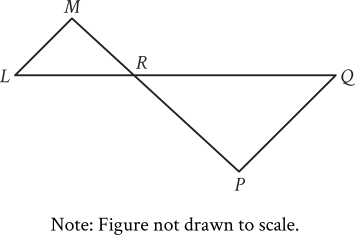
In the figure, intersects at point , and is parallel to . The lengths of , , and are , , and , respectively. What is the length of ?
Explanation
Choice D is correct. The figure shows that angle and angle are vertical angles. Since vertical angles are congruent, angle and angle are congruent. It’s given that is parallel to . The figure also shows that intersects and . If two parallel segments are intersected by a third segment, alternate interior angles are congruent. Thus, alternate interior angles and are congruent. Since triangles and have two pairs of congruent angles, the triangles are similar. Sides and in triangle correspond to sides and , respectively, in triangle . Since the lengths of corresponding sides in similar triangles are proportional, it follows that . It's given that the lengths of , , and are , , and , respectively. Substituting for , for , and for in the equation yields . Multiplying each side of this equation by yields , or . It's given that intersects at point , so . Substituting for and for in this equation yields , or . Therefore, the length of is .
Choice A is incorrect and may result from conceptual or calculation errors.
Choice B is incorrect. This is the length of , not .
Choice C is incorrect and may result from conceptual or calculation errors.